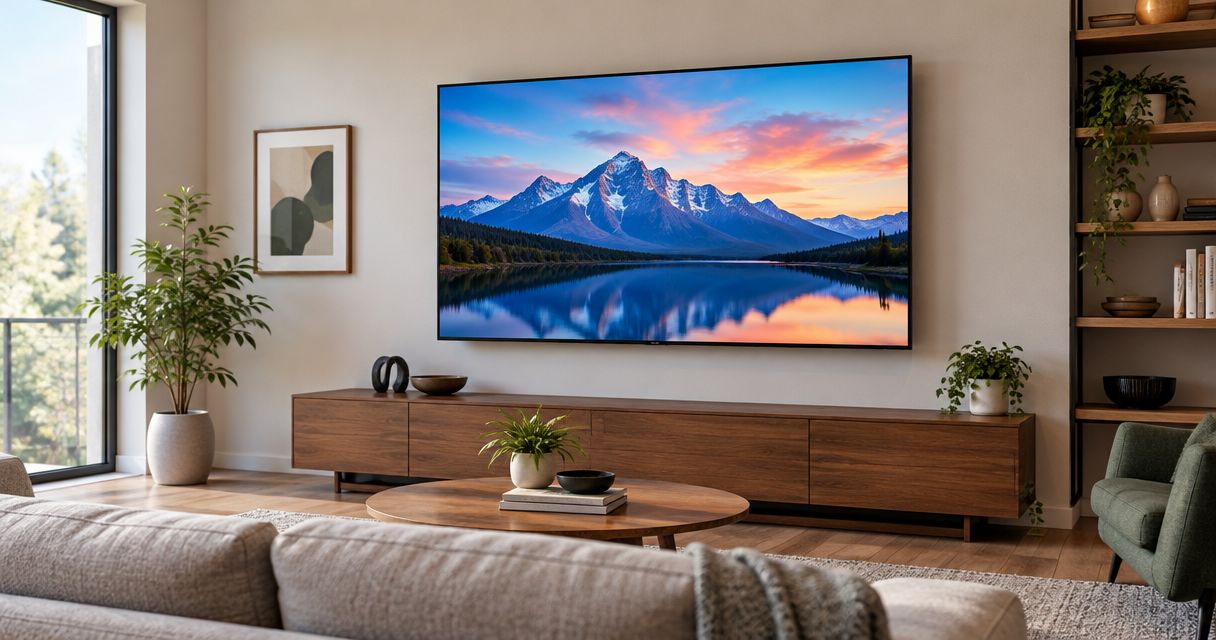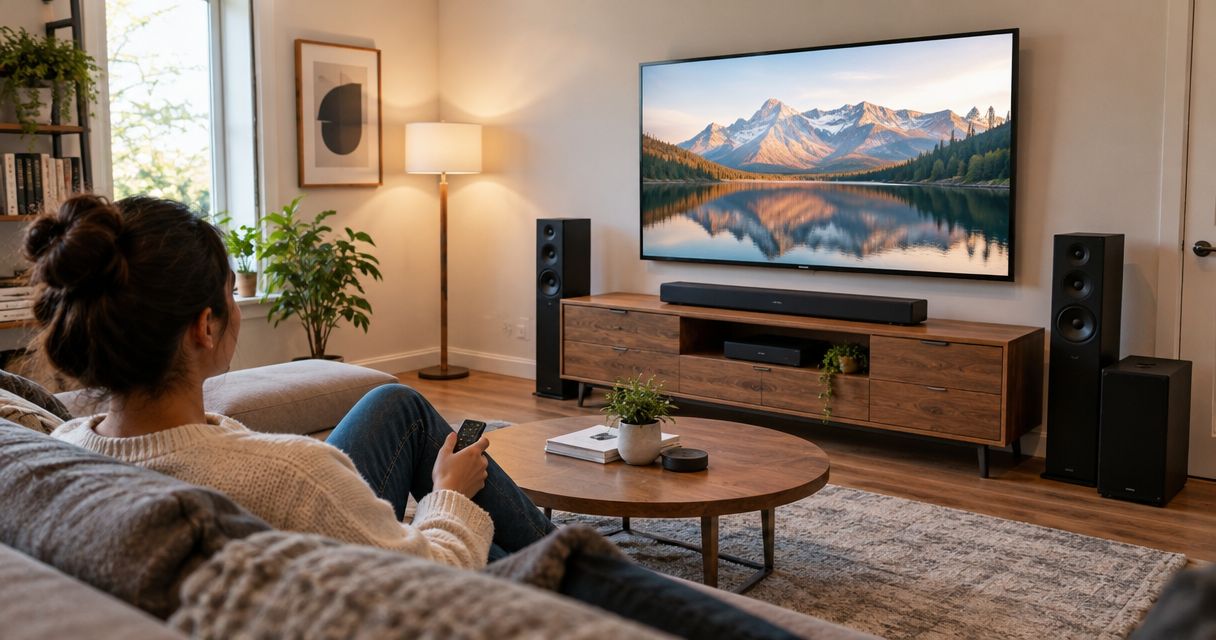
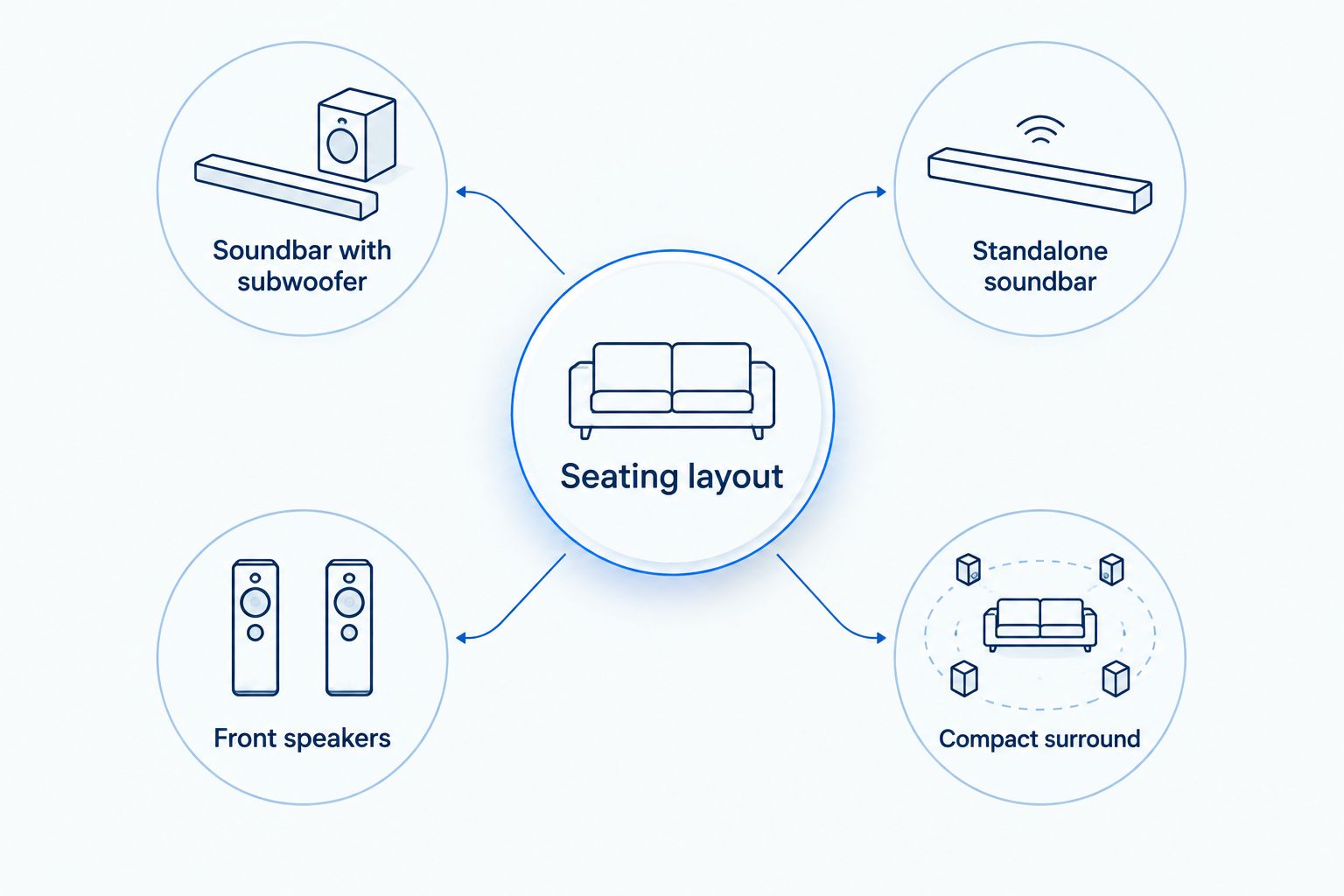
Best overall: a soundbar with a separate subwoofer. Best for shared walls: a standalone soundbar. Best for dialogue control: a passive front-speaker system. Best for discrete surround: a compact surround system. The best home theater systems for small rooms in 2026 fit your seating layout, leave walkways clear, and provide useful sound at the volume you actually use.
- The best home theater systems for small rooms start with a soundbar and subwoofer when floor space permits.
- Choose a standalone soundbar when shared walls and limited space matter more than deep bass.
- Choose front speakers for separate dialogue control, or compact surround when rear-speaker placement is practical.
- Bestlinktek provides TV mounting services; confirm location coverage and installation scope before booking.
Why this matters
A small living room does not automatically need the smallest speaker package. It needs a system that works around the sofa, television, doors, and neighboring rooms. Extra speakers become a disadvantage when their only possible locations obstruct a walkway or sit immediately beside someone's head.
For your 2026 shortlist, separate equipment selection from installation. Bestlinktek provides residential TV mounting and other in-home installation services; that does not establish that a particular audio package, speaker-wiring job, or location is covered. Confirm the exact work before buying equipment around an assumed installation service.
What makes the best small-room home theater system?
Use these criteria before comparing brands or speaker counts:
- Seating layout: Match the speaker arrangement to where people actually sit, including seats away from the center.
- Dialogue control: Decide whether you need a dedicated center channel or model-specific speech settings.
- Bass control: Favor adjustable bass and practical subwoofer placement over maximum output.
- Connection fit: Check the television's audio outputs against the exact system's inputs and supported formats.
- Physical fit: Account for the TV's lower edge, furniture depth, power outlets, and unobstructed walking space.
- Installation scope: Identify who supplies brackets, routes cables, handles wall work, and configures the equipment.
These criteria put room fit ahead of feature lists. A system that requires impractical speaker placement is the wrong purchase, even when its specifications look impressive.
Small-room home theater systems at a glance
These are system types, not tested product-model winners. Their positions reflect the different installation and listening needs described below, rather than a claim that every soundbar outperforms every speaker package.
| System type | Best for | Standout feature | Key limitation |
|---|---|---|---|
| Soundbar with subwoofer | Balanced movie listening without rear speakers | Separate bass unit and compact front enclosure | Subwoofer needs its own suitable position |
| Standalone soundbar | Shared walls and minimal equipment | Single front enclosure without a separate bass cabinet | Limited deep-bass capability relative to a suitable separate subwoofer |
| Front speakers | Separate dialogue adjustment | Dedicated center channel in a 3.1 configuration | Requires an amplifier or receiver and speaker wiring |
| Compact surround | Directional effects with rear-speaker space | Discrete surround channels in a 5.1 configuration | More placement, cabling, and power planning |
The decision starts with seating layout, not the largest channel count. If your sofa leaves no workable surround-speaker positions, compare the front-only options first.
1. Soundbar with subwoofer: best for balanced movie listening
A soundbar places the front audio system in a single enclosure near your television. A separate subwoofer handles low-frequency sound, giving you more bass capability without adding rear speakers. Connections and supported audio formats depend on the exact model.
This is the default 2026 recommendation for a small living room where you want movie impact without arranging speakers around the seating area. The qualification matters: you still need somewhere sensible to put the subwoofer.
Soundbar with subwoofer pros
- Keeps the front speaker arrangement compact.
- Adds a separate bass source without requiring surround speakers.
- Avoids the separate receiver required by a conventional passive-speaker setup.
- Offers a middle ground between a single enclosure and a room-wide speaker arrangement.
Soundbar with subwoofer cons
- Adds another cabinet, cable, and power requirement.
- Bass placement needs attention; the empty corner is not automatically the best location.
- Center-channel design and dialogue settings vary between models.
Best for: You watch films and television regularly, want more bass than a standalone soundbar provides, and can accommodate a separate cabinet.
Before choosing a model, check that the soundbar does not cover the screen or the TV's remote-control sensor. Confirm where its cables exit, particularly if the television sits close to the wall. A wireless subwoofer connection does not eliminate the need for electrical power.
Verdict: Buy a soundbar with a subwoofer if you have a practical bass-unit position and do not need discrete surround speakers.
2. Standalone soundbar: best for shared walls and minimal equipment
A standalone soundbar keeps the audio system in one front enclosure. It suits rooms where another cabinet would compete with furniture, access, or storage. Its connections, speaker arrangement, and sound controls remain model-specific.
For shared-wall living in 2026, the advantage is restraint rather than silence. Removing a separate subwoofer reduces the equipment you need to place, but it does not prevent sound from reaching neighbors.
Standalone soundbar pros
- Requires no separate subwoofer position.
- Keeps the equipment footprint concentrated near the television.
- Avoids running speaker cables around the seating area.
- Makes sense when you prioritize everyday television over deep movie bass.
Standalone soundbar cons
- Deep bass is constrained by the enclosure and driver design.
- A wide enclosure can still be awkward on narrow furniture.
- Virtual surround processing is not the same arrangement as physical surround speakers.
Best for: You live with shared walls, have limited floor space, or want fewer visible components.
Listen for speech intelligibility rather than choosing by the loudest demonstration. Check whether dialogue enhancement and night listening controls exist on the exact model; neither feature is guaranteed by the word soundbar. Also confirm that the unit works with your television's available audio connection.
Verdict: Buy a standalone soundbar when a compact, front-only setup matters more than deep bass or discrete surround effects.
3. Front speakers: best for separate dialogue control
A passive front-speaker system uses separate left, center, and right speakers powered by an amplifier or receiver. Adding a subwoofer creates a 3.1 configuration: 3 main channels plus a low-frequency effects channel. The dedicated center gives you a separate channel to adjust for dialogue-heavy content.
This arrangement suits a small room with enough front-wall space for actual speaker placement. It does not suit a cabinet where the center speaker must sit behind a solid door or where the left and right speakers have no usable separation.
Front speakers pros
- Provides a dedicated center channel for dialogue adjustment.
- Lets you position the left and right speakers separately.
- Allows compatible components to be selected individually.
- Supports a front-focused arrangement without rear-speaker installation.
Front speakers cons
- Requires space and ventilation for an amplifier or receiver.
- Adds speaker cables and more connection points.
- Needs careful center-speaker placement near the screen.
Best for: You want direct control over dialogue balance and accept more visible equipment at the front of the room.
Check speaker and amplifier compatibility before treating separate components as a package. Include the receiver's ventilation requirements in your furniture plan, not just its external dimensions. Keep the center speaker unobstructed and follow the manufacturer's placement instructions.
A dedicated center channel is a useful control, not an automatic cure for every unclear soundtrack. Source settings, room reflections, speaker placement, and the recording itself still affect what you hear.
Verdict: Buy a front-speaker system if dialogue adjustment justifies the receiver, wiring, and additional front-wall space.
4. Compact surround: best for discrete directional effects
A conventional 5.1 system uses 5 main channels and a low-frequency effects channel. Its front left, center, front right, and surround speakers create distinct playback positions around the listening area. Compact speakers reduce cabinet size, but they do not remove placement requirements.
For a 2026 small-room plan, choose this arrangement only after identifying suitable surround-speaker locations. A sofa against a wall does not automatically rule it out, but the actual angles, clearances, and manufacturer's guidance must work.
Compact surround pros
- Uses physical surround speakers for discrete directional channels.
- Retains a dedicated center channel in a conventional layout.
- Gives each speaker a defined role around the seating area.
- Suits movie-focused listening when the room accommodates the layout.
Compact surround cons
- Requires more speaker positions than the front-only alternatives.
- Adds cable routing or power planning around the room.
- Can create uneven listening when a surround speaker sits too close to a seat.
Best for: You prioritize directional movie effects and have usable speaker positions beside or behind the seating area, as specified for the system.
Read wireless claims carefully. A speaker can receive audio wirelessly and still need an outlet or a connection to another component. Map those requirements before buying stands or deciding that the rear of the room will remain cable-free.
Verdict: Buy compact surround only when the full layout works without compromising seating or walkways; otherwise, skip it.
How the systems are ranked
The ranking favors practical fit for a small living room: equipment footprint, dialogue adjustment, bass placement, connection requirements, and installation complexity. It does not rank unnamed products on measured sound quality.
The soundbar-and-subwoofer arrangement takes the default position because it adds separate bass without requiring rear speakers. The remaining options solve different problems: fewer components, separate dialogue control, or discrete surround. Your room constraint determines the winner.
Plan the installation before choosing equipment
For home theater planning, Bestlinktek's stated TV mounting service is distinct from a commitment to install every audio component. Confirm your location and the requested work directly; national content does not establish nationwide booking availability.
Before requesting work, prepare a clear scope:
- TV position: Identify the screen, mounting location, wall material, and nearby outlets.
- Audio position: Show where the soundbar, center speaker, or subwoofer will sit.
- Cable route: Distinguish visible cable management from work inside a wall.
- Supplied hardware: Specify who provides the mount, brackets, cables, and other equipment.
- Completion check: Agree on which connections and playback functions the appointment covers.
For the 2026 installation plan, ask about exclusions before committing to hardware. TV mounting does not by itself include new outlets, concealed wiring, audio calibration, or speaker mounting. Those tasks need an explicit agreement rather than an assumption.
Check your TV mounting scope
Confirm location coverage, supplied hardware, and the work included before planning your installation.
Which small-room home theater system should you choose?
Choose a soundbar with a separate subwoofer unless your room gives you a specific reason not to. It is the default here because it avoids rear-speaker placement while providing a separate bass unit.
Choose a standalone soundbar when equipment footprint and shared-wall restraint take priority. Choose front speakers when you want a separately adjustable center channel. Choose compact surround when directional effects matter enough to justify the full speaker layout.
Do not buy extra channels on the assumption that placement will resolve itself. Decide where the equipment goes first, then select a system that fits those positions.
FAQ
What's the best home theater system for a small living room?
A soundbar with a separate subwoofer is the default recommendation when you have room for the bass cabinet but not rear speakers. Choose a standalone soundbar if minimizing equipment matters more than deep bass.
Is a soundbar better than a surround system in a small room?
A soundbar is the better fit when the room cannot accommodate suitable surround-speaker positions. A compact surround system makes sense when you can place its speakers without obstructing seating or walkways.
What does a 3.1 home theater system include?
A conventional 3.1 system includes front left, center, and front right channels plus a low-frequency effects channel, usually reproduced by a subwoofer. Passive speakers also require compatible amplification.
Do wireless surround speakers still need power cables?
Wireless audio does not mean a speaker operates without power. Check whether each speaker needs an outlet, batteries, or a connection to another component before planning its location.
Should I choose a standalone soundbar for an apartment?
Choose a standalone soundbar when limited floor space and fewer components are your priorities. It does not prevent noise transmission through shared walls, so volume and placement still matter.
Does Bestlinktek install every home theater component?
Bestlinktek's stated services include TV mounting, not a blanket commitment to install every home theater component. Confirm location coverage, audio-related work, supplied hardware, and exclusions before booking.
One last thing
Check remote-control access before deciding where the soundbar belongs. A neat-looking placement can block the television's sensor or cover the screen's lower edge. Test the proposed position with the television, furniture, and cables in place before drilling or purchasing a mounting accessory.