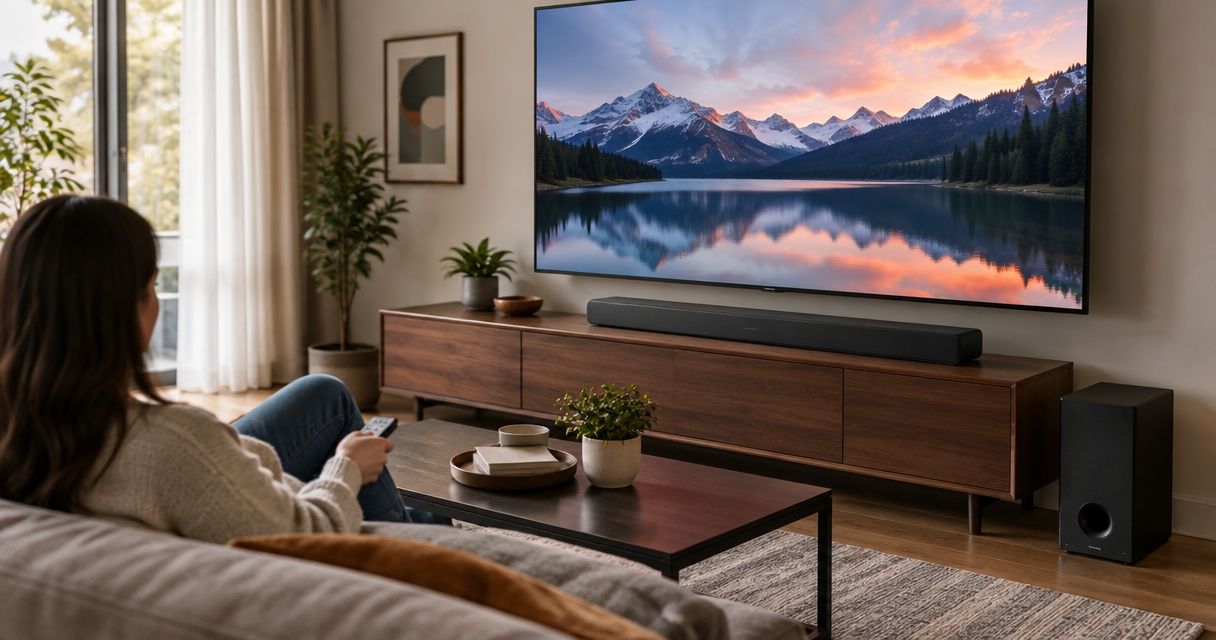
Best overall: Sonos Arc Ultra. Best for included surround speakers: Samsung HW-Q990D. Best for a compact setup: Yamaha SR-C20A. This 2026 guide compares the best soundbars for home theater by speaker layout, TV connections, dialogue features, and installation requirements.
- Sonos Arc Ultra leads the best soundbars for home theater shortlist for a single-bar Dolby Atmos starting point.
- Samsung HW-Q990D suits viewers who want a separate subwoofer and rear speakers in the package.
- Sony BRAVIA Theatre Bar 9 suits setups that need an additional HDMI source connection.
- Bose Smart Ultra Soundbar prioritizes dialogue adjustment; Yamaha SR-C20A fits compact, straightforward TV setups.
- Bestlinktek provides TV mounting services; confirm service scope and booking availability before arranging installation.
Why this matters
A soundbar recommendation is incomplete without the TV, room, and speaker arrangement. A bar beneath the screen solves a different problem from a package with speakers behind the couch. Start with the layout you can actually accommodate.
For a 2026 installation, settle the soundbar position before finalizing the TV mounting height. Bestlinktek provides TV mounting services; confirm the requested work and booking availability rather than assuming audio setup, electrical work, or supplied hardware is included.
Bestlinktek is a fit for residential customers seeking TV mounting services alongside a planned home theater setup. Choose the audio hardware separately, then make the installation scope explicit.
What makes the best soundbars for home theater?
- Speaker layout: Decide whether you want a standalone bar or physical speakers behind the seating position. Simulated surround and separate rear speakers are different arrangements.
- TV connection: Check the television's HDMI ARC or eARC support, available ports, and supported audio formats. A matching connector alone does not establish format compatibility.
- Dialogue controls: Look for speech enhancement and center-channel adjustment where available. These controls address different listening needs from adding bass.
- Room fit: Upward-firing effects depend on ceiling geometry. Furniture, seating position, and speaker placement also affect the result.
- Expansion requirements: Establish whether a subwoofer and rear speakers are included, optional, or unsupported. Wireless speakers still need power.
- Installation access: Preserve clearance beneath the picture, access to connections, and space around speaker drivers. Check the manufacturer's placement instructions before drilling.
Best soundbars at a glance for 2026
| Rank and soundbar | Best for | Standout feature | Key limitation |
|---|---|---|---|
| 1. Sonos Arc Ultra | A single-bar Dolby Atmos starting point | Dolby Atmos playback with optional Sonos speaker expansion | No separate HDMI source input |
| 2. Samsung HW-Q990D | An included surround-speaker package | Separate subwoofer and rear speakers | Requires more placement and power planning |
| 3. Sony BRAVIA Theatre Bar 9 | Connecting a source through the soundbar | HDMI input alongside the TV connection | Separate subwoofer and rear speakers are optional additions |
| 4. Bose Smart Ultra Soundbar | Dialogue-focused listening | AI Dialogue Mode | No separate HDMI source input |
| 5. Yamaha SR-C20A | Compact, straightforward TV audio | HDMI ARC, optical input, and built-in bass drivers | No Dolby Atmos support |
These are configuration-based recommendations, not laboratory sound-quality scores. Check each manufacturer's current product documentation for compatibility with your television and source devices.
1. Sonos Arc Ultra: best home theater soundbar for a single-bar start
Sonos Arc Ultra combines Dolby Atmos playback with a path to adding compatible Sonos surround speakers and a subwoofer. It suits a living room where you want the front of the system established before deciding whether to add speakers elsewhere.
Sonos Arc Ultra pros:
- Dolby Atmos support for compatible content and connections.
- Optional expansion with compatible Sonos speakers.
- Speech enhancement controls for dialogue-focused listening.
Sonos Arc Ultra cons:
- No separate HDMI input for a console or streaming player.
- Physical rear speakers and a separate subwoofer are not included with the standalone bar.
Connect source devices to the television and verify which audio formats the TV can pass through. This matters especially when the television also serves a console, disc player, and external streaming device.
Best for: Viewers who want a Dolby Atmos soundbar now and the option to add compatible speakers later.
Verdict: Buy Sonos Arc Ultra for a single-bar starting point; skip it if an HDMI source input is essential.
2. Samsung HW-Q990D: best home theater soundbar for included surrounds
Samsung HW-Q990D combines a soundbar, separate subwoofer, and rear speakers. Its defining advantage for this shortlist is the package arrangement: you can plan physical surround placement from the outset rather than treating rear speakers as a later decision.
Samsung HW-Q990D pros:
- Rear speakers are part of the package.
- A separate subwoofer handles dedicated bass reproduction.
- HDMI inputs accommodate external source devices.
Samsung HW-Q990D cons:
- Rear speakers need suitable positions and access to power.
- The complete system occupies more room than a standalone bar.
Decide where the rear speakers will go before choosing this package. A couch against the back wall requires different placement planning from seating with open space behind it; follow Samsung's positioning guidance rather than placing speakers wherever an outlet happens to be.
Best for: Movie viewers who want physical surround speakers and can accommodate the complete system.
Verdict: Buy Samsung HW-Q990D when rear-speaker placement is practical; skip it when the room cannot support the package.
3. Sony BRAVIA Theatre Bar 9: best home theater soundbar for source routing
Sony BRAVIA Theatre Bar 9 supports Dolby Atmos and includes an HDMI input for a source device. That gives you an alternative to connecting every device directly to the television.
Sony BRAVIA Theatre Bar 9 pros:
- HDMI source input expands connection choices.
- Dolby Atmos support serves compatible movie soundtracks.
- Compatible optional rear speakers and subwoofers support system expansion.
Sony BRAVIA Theatre Bar 9 cons:
- The standalone bar does not include a separate subwoofer or rear speakers.
- Source routing still requires checking video and audio compatibility across the entire connection chain.
Do not assume that connecting a console through a soundbar preserves every video setting automatically. Match the console's output requirements to the soundbar's passthrough specifications and the television's input capabilities.
Best for: Households that want an HDMI source connection on the soundbar and an expandable speaker arrangement.
Verdict: Buy Sony BRAVIA Theatre Bar 9 when its connection options solve your setup; hold until compatibility is confirmed.
4. Bose Smart Ultra Soundbar: best home theater soundbar for dialogue controls
Bose Smart Ultra Soundbar supports Dolby Atmos and includes AI Dialogue Mode, Bose's named feature for adjusting speech presentation. It belongs on the shortlist when following conversation matters more to you than starting with a package of separate speakers.
Bose Smart Ultra Soundbar pros:
- Dedicated dialogue processing addresses speech-focused listening.
- Dolby Atmos support accommodates compatible content.
- Compatible optional bass modules and surround speakers allow expansion.
Bose Smart Ultra Soundbar cons:
- No separate HDMI source input.
- A separate bass module and surround speakers are not included with the standalone bar.
Dialogue processing does not eliminate every cause of unclear speech. Check the television's audio output settings, the soundbar's listening mode, and the soundtrack itself before concluding that additional speakers are necessary.
Best for: Viewers who prioritize speech controls in a standalone Dolby Atmos soundbar.
Verdict: Buy Bose Smart Ultra Soundbar for its dialogue-focused feature set; skip it if source passthrough is required.
5. Yamaha SR-C20A: best home theater soundbar for compact TV setups
Yamaha SR-C20A is a compact soundbar with HDMI ARC, optical connectivity, Bluetooth, and built-in bass drivers. It provides a simpler alternative when your goal is TV audio without a separate subwoofer or rear-speaker arrangement.
Yamaha SR-C20A pros:
- Compact form suits space-constrained TV furniture.
- HDMI ARC and optical inputs cover common television connections.
- Clear Voice provides a speech-focused listening option.
Yamaha SR-C20A cons:
- No Dolby Atmos support.
- It is not a starting point for a matching rear-speaker home theater package.
Treat Yamaha SR-C20A as a compact TV-audio choice, not an equivalent replacement for the surround packages above. Its narrower scope is useful when simplicity is the actual requirement.
Best for: Bedrooms, smaller TV areas, and viewers who do not want separate speakers around the room.
Verdict: Buy Yamaha SR-C20A for compact TV audio; skip it for an Atmos or physical-surround objective.
Match the speaker layout to your room
Channel labels describe speaker roles, not a guarantee of listening quality. A 2.1-channel layout describes left and right channels plus a bass channel; a 3.1-channel layout adds a center channel. A 5.1-channel layout includes surround channels as well. Soundbars can reproduce or simulate these roles differently, so read the actual speaker configuration.
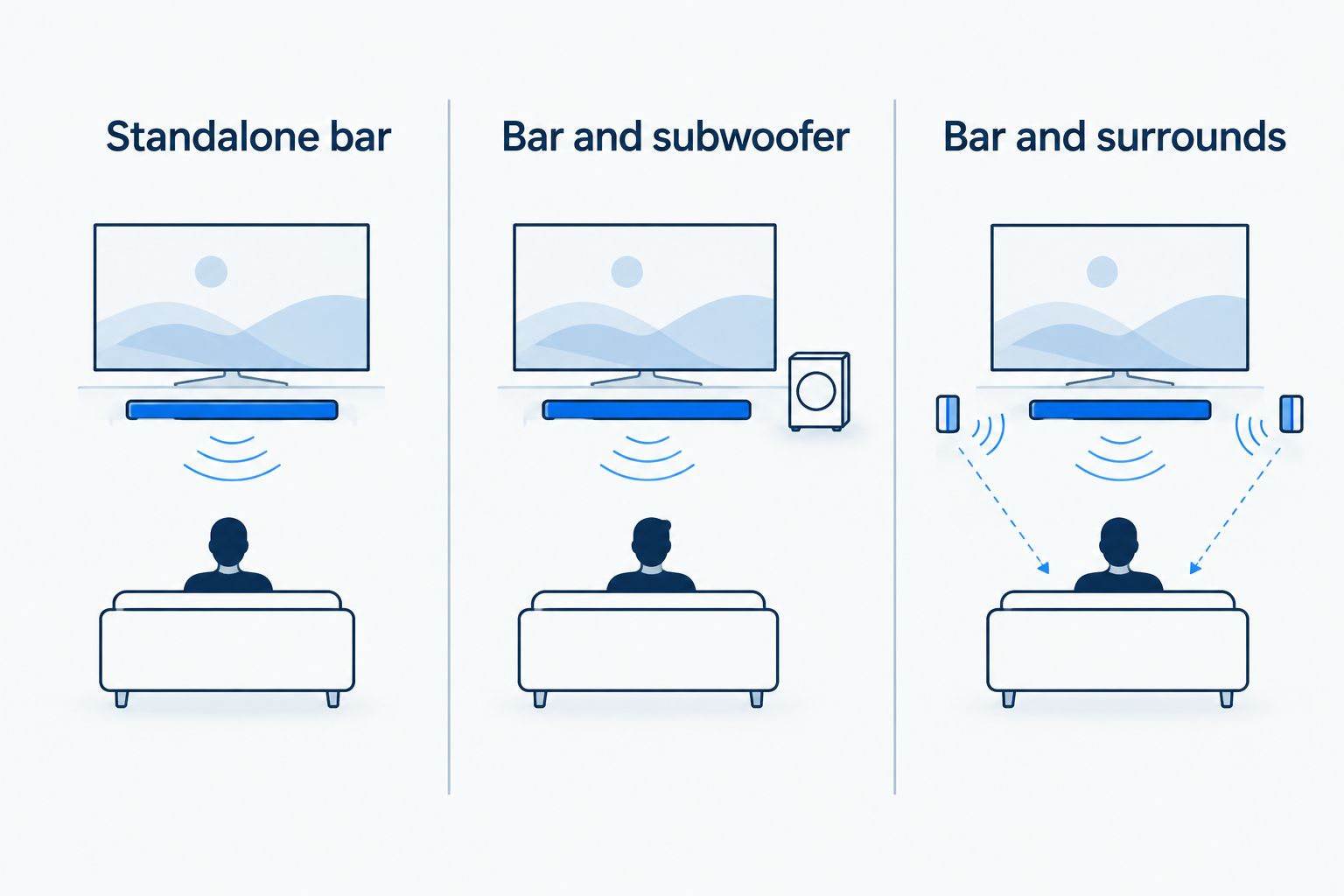
Choose between these three layouts before comparing extra features:
- Standalone bar: Keeps the hardware concentrated beneath the television. Best for avoiding additional speaker positions; limited by the lack of physical rear speakers.
- Bar and subwoofer: Separates bass reproduction from the bar. Best for adding a dedicated bass component; requires another placement decision.
- Bar and surrounds: Adds speakers around the listening area. Best for physical surround placement; requires space and power beyond the television wall.
An upward-firing speaker needs an appropriate path toward the ceiling to create its intended reflected effect. A shelf directly above the soundbar obstructs that path. Follow the model's clearance instructions rather than assuming every position beneath a TV works.
Check the installation before choosing
Use this sequence for a 2026 setup. It separates equipment compatibility from the work required in your home.
- Check TV connections. Identify the ARC or eARC port and review supported audio formats in the TV documentation.
- Map source devices. Decide whether each streaming player, console, or disc player connects to the TV or a soundbar input.
- Confirm placement. Check the soundbar dimensions against the furniture, screen clearance, and manufacturer mounting instructions.
- Plan speaker power. Locate outlets for a separate subwoofer and rear speakers without assuming wireless means battery-powered.
- Define installation scope. Specify mounting, cable routing, hardware responsibility, and any separately required electrical work.
Bestlinktek provides residential TV mounting services. Confirm whether your requested audio-related work falls within the agreed service scope, and establish who supplies the bracket, soundbar hardware, and cables. Do not assume a TV mounting request includes wall repairs or changes to electrical wiring.
How the ranking works
This 2026 ranking prioritizes distinct use cases rather than treating every soundbar as interchangeable. Sonos Arc Ultra takes the default position for its standalone Atmos configuration and expansion path; Samsung HW-Q990D serves the included-surround use case. Sony, Bose, and Yamaha each address a separate connection, dialogue, or space requirement.
The criteria are speaker layout, TV connectivity, dialogue features, room fit, expansion, and installation access. No listening-test results or measured performance scores are claimed here.
Which soundbar should you choose?
Choose Sonos Arc Ultra if you want the default standalone Dolby Atmos recommendation. Choose Samsung HW-Q990D instead when physical rear speakers are part of the plan from the beginning.
For a 2026 purchase decision, resolve your nonnegotiable requirement first: Sony BRAVIA Theatre Bar 9 for an HDMI source input, Bose Smart Ultra Soundbar for dialogue-focused controls, or Yamaha SR-C20A for a compact arrangement. A feature you cannot use in your room should not decide the purchase.
FAQ
What's the best soundbar for home theater in 2026?
Sonos Arc Ultra is this guide's default choice for a standalone Dolby Atmos starting point. Samsung HW-Q990D is the better configuration match when you want a separate subwoofer and rear speakers included.
Is a soundbar with rear speakers better than a standalone bar?
A soundbar package with rear speakers provides physical sound sources around the seating area. Choose it when you have suitable speaker positions and power access; choose a standalone bar when additional speakers do not fit the room.
Do I need HDMI eARC for a soundbar?
You do not need HDMI eARC for every soundbar setup. The required connection depends on the television, soundbar, source device, and audio format; check the supported combination in their documentation.
Which soundbar should I choose for clearer dialogue?
Bose Smart Ultra Soundbar belongs on a dialogue-focused shortlist because it includes AI Dialogue Mode. Sonos Arc Ultra and Yamaha SR-C20A also provide speech-focused controls, so compare the complete setup rather than the feature name alone.
Can I put a Dolby Atmos soundbar inside a cabinet?
Do not place a soundbar inside a cabinet unless its manufacturer permits that arrangement. Enclosed placement can obstruct upward-firing or side-firing drivers, so follow the model's clearance instructions.
Does a wireless subwoofer still need a power outlet?
Yes, the separate wireless subwoofers discussed here require electrical power. Wireless describes the audio connection, not freedom from a power cable.
Can Bestlinktek help with my home theater installation?
Bestlinktek provides residential TV mounting services. Confirm booking availability, requested audio-related work, hardware responsibility, and exclusions before arranging service; national content does not establish local installation availability.
One last thing
Check what the soundbar will block before deciding where the TV goes. A bar placed in front of the television can obstruct the picture or remote-control receiver, depending on the equipment. Compare the actual TV and soundbar dimensions, preserve the manufacturer's clearances, and settle both positions before mounting either component.